Atradius Atrium
Atrium - für ein vereinfachtes und transparentes Management Ihrer Kreditversicherungspolice. Login Atradius Atrium

 Deutschland
 Australien
 Belgien
 Brazil
 Bulgarien
 China
China
 Dänemark
Deutschland
Dänemark
Deutschland
 Finnland
 Frankreich
 Griechenland
 Gruppe
 Hongkong
 Indien
 Irland
 Italien
 Japan
Japan
 Kanada
 Litauen
 Mexiko
 Neuseeland
 Niederlande
 Norwegen
 Österreich
 Polen
Polen
 Portugal
 Rumänien
 Schweden
 Schweiz
 Singapur
 Slowakei
 Slowenien
 Spain
Spain
 Tschechische Republik
 Türkei
 Ungarn
 Vereinigte Arabische Emirate
 Vereinigtes Königreich
 Vereinigte Staaten

Despite ongoing economic headwinds from US tariffs, trade policy uncertainty, and geopolitical risks, Canadian businesses continue to rely heavily on trade credit to support sales and customer relationships. On average, around half of business-to-business (B2B) sales are transacted on credit terms, making Canada the most trade credit reliant market in North America. By comparison, US businesses use of trade credit less often, while Mexican companies are considerably more cautious, extending credit for only around 30% of B2B sales and preferring upfront payment. In Canada, manufacturing SMEs are the most active users of B2B trade credit. While most businesses have maintained stable trade credit policies in recent months, companies increasing credit offerings significantly outnumber those reducing them. However, both groups remain smaller than the regional average, underscoring the overall stability of trade credit practices in Canada.
Although Canada appears the most trade credit reliant market in North America, businesses tend to offer shorter payment terms than their regional peers. This reflects an approach that balances broad use of trade credit with effective cash flow and payment risk management. Nearly two-thirds of B2B invoices are due within one month from invoicing. Longer payment terms are less common, with fewer Canadian businesses extending terms beyond two months. This indicates that businesses support customers through the use of trade credit, while limiting exposure to payment risk by encouraging faster settlement of invoices. SMEs in construction and services are more likely to offer extended payment terms to B2B customers than their peers across other business segments. Compared with the regional average, Canadian businesses are significantly more likely to maintain existing payment arrangements, highlighting a preference for predictability in B2B trading relationships.
Survey data suggest that B2B payment behaviour in Canada has changed little in recent months. Around seven in ten companies in both the market and North America continue to deal with late payment from business customers. In Canada, overdue invoices account for an average of 25% of B2B receivables, slightly above the regional average. Most Canadian suppliers report no change in the level of late payments, with stability far more common than across North America. However, among those experiencing a shift, more businesses say late payments have increased than decreased. This indicates that, although payment trends remain broadly stable, late payment remains a challenge for Canadian suppliers.
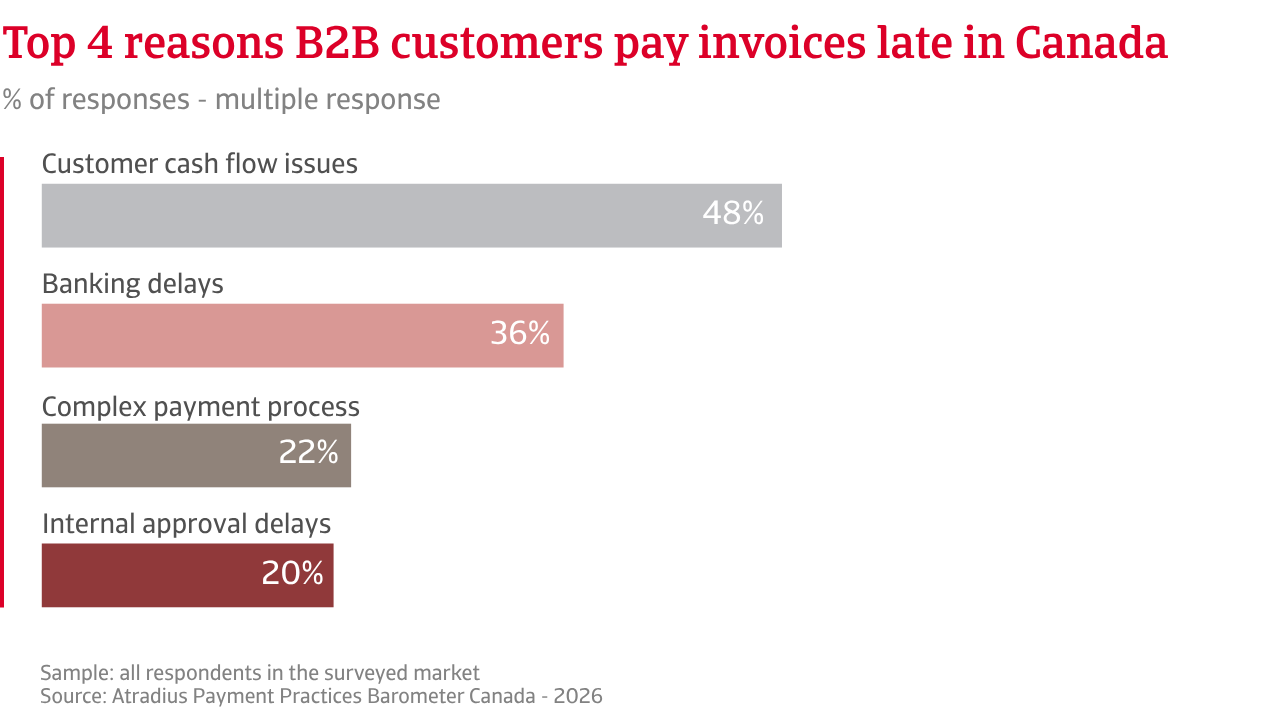
Customer cash flow bottlenecks are the leading cause of late payment in Canada, cited by nearly half of businesses, broadly in line with the North American average. Banking delays rank second, affecting around 36% of companies across both Canada and the wider region. Beyond these reasons, Canadian businesses are more likely than their regional peers to attribute late payments to inefficiencies in payment administration and processing. This suggests that operational challenges, alongside customer liquidity pressures, continue to play an important role in delaying payment.
According to survey data, widespread late payment across Canada has not prevented businesses from keeping collection times broadly in line with agreed payment terms. This is in line with the relatively low levels of bad debt reported by Canadian firms. More than seven in ten Canadian businesses, a notably higher share than across North America, report write-offs of less than 1% of B2B invoices, suggesting that most overdue invoices are ultimately collected rather than written off. When receivables are written off, the most common reason is customer inactivity or unreachability, cited by one-third of businesses, a notably higher share than across North America.
However, with economic challenges expected to continue, longer payment delays could put more pressure on suppliers' cash flow and working capital. This is already a concern for many Canadian businesses. More than one-third say late payment reduces the cash available for day-to-day operations, a higher share than across North America. Canadian businesses are also more likely to face higher financing costs, suggesting that some need to use more expensive funding to cover temporary cash shortages. Overall, the findings suggest that payment delays can increase financing costs and reduce financial flexibility.
Late payment affects seven in ten Canadian businesses and accounts for one quarter of B2B receivables
To manage the impact of customer payment risk on the business, Canadian businesses are adopting a range of measures to protect cash flow and limit exposure to non-payment. The most common approach is to trade on cash terms or request advance or secured payment, although this is less widespread than across North America. Canadian businesses are also more likely than their regional peers to shorten payment terms, automate payment reminders, and digital payment processes, use credit insurance, and take legal action when necessary. These measures reflect a proactive approach to managing payment risk, helping businesses maintain control over receivables while continuing to support B2B trade on credit.

Looking ahead to the next months, Canadian businesses are preparing for a more challenging payment environment and appear less confident than their North American peers about the outlook for B2B payment behaviour. While three in five companies do not expect any significant change in customer payment practices, those anticipating a worsening outnumber those expecting an improvement by a much wider margin than across the region. This cautious outlook likely reflects ongoing economic uncertainty and concerns about customers' ability to maintain healthy cash flow in the months ahead. The most pessimistic expectations come from large trading companies, which are more likely than other business segments to anticipate a deterioration in B2B payment behaviour.
Expectations of a more challenging payment environment are matched by concerns about the financial health of B2B customers. More than one in four Canadian businesses expect customer insolvency risk to increase in the coming months, although most do not expect a rise in actual insolvencies. This suggests that businesses are more concerned about slower payments and cash flow pressures than about a sharp increase in customer failures.
Concerns about B2B payment behaviour are mirrored in expectations for profitability. Canadian businesses are notably less optimistic than their North American peers about profit margins in the months ahead. While most expect margins to remain stable, relatively few anticipate improvement, and a growing minority foresee deterioration. This points to expectations of subdued financial performance amid continued economic uncertainty and pressure on customer cash flow.
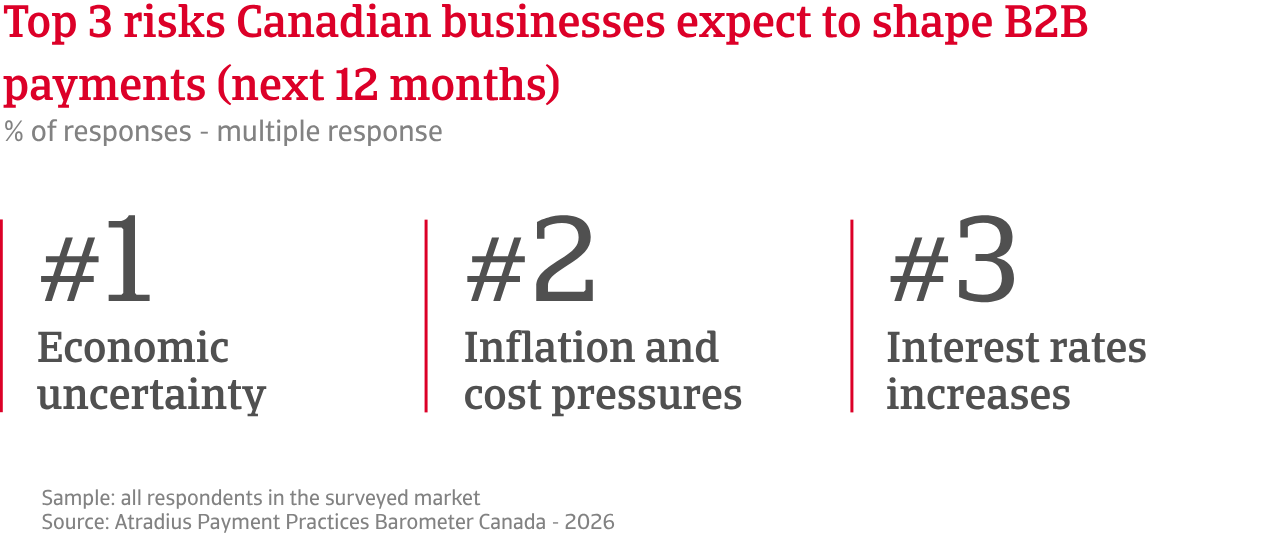
When asked about the factors most likely to disrupt B2B customer payment behaviour in the months ahead, Canadian businesses point first to the broader economic environment. Nearly seven in ten cite an economic slowdown as their main concern, while almost six in ten highlight inflation and rising cost pressures. Many also worry about the impact of higher interest rates on customer cash flow. Compared with businesses across North America, Canadian companies are more concerned about supply chain disruptions, sector-specific downturns, and fraud risk. Geopolitical instability is also a slightly greater concern. By contrast, currency volatility attracts much less attention in Canada than elsewhere in the region.
Overall, the findings suggest that Canadian businesses expect B2B payment behaviour to be shaped mainly by weak economic growth, ongoing cost pressures and challenges affecting specific industries. These concerns help explain why many companies remain cautious about the outlook for customer payment performance and profitability in the months ahead.
For a full overview of the 2026 survey results for Canada, please download the market specific report from the related documents section below. Insights into North America are available in the related content section below.
To explore how to strengthen your own credit risk strategy, get in touch with us and see how we can help you stay ahead.
Fragen?
Rechtlicher Hinweis
