Atradius Atrium
Atrium - für ein vereinfachtes und transparentes Management Ihrer Kreditversicherungspolice. Login Atradius Atrium

 Deutschland
 Australien
 Belgien
 Brazil
 Bulgarien
 China
China
 Dänemark
Deutschland
Dänemark
Deutschland
 Finnland
 Frankreich
 Griechenland
 Gruppe
 Hongkong
 Indien
 Irland
 Italien
 Japan
Japan
 Kanada
 Litauen
 Mexiko
 Neuseeland
 Niederlande
 Norwegen
 Österreich
 Polen
Polen
 Portugal
 Rumänien
 Schweden
 Schweiz
 Singapur
 Slowakei
 Slowenien
 Spain
Spain
 Tschechische Republik
 Türkei
 Ungarn
 Vereinigte Arabische Emirate
 Vereinigtes Königreich
 Vereinigte Staaten

The Greek economy continues to show resilience, supported by domestic demand and EU funded investment. Rising energy prices, however, have pushed up inflation and operating costs for businesses. With bank lending more selective, many companies increasingly lean on supplier credit to keep trading with business-to-business (B2B) customers.
Survey evidence shows that almost two thirds of B2B sales in Greece now take place on credit. This sits above the Western European average and underlines how dependent Greek firms remain on supplier financing. Manufacturing and trade firms are more likely to extend credit to stay competitive and support long-term customer relationships. Most Greek suppliers set payment terms within a 30-day credit window, in line with Western Europe. Longer terms, up to two months and beyond, are more common in Greece, yet suppliers still apply cautious credit policies to protect liquidity while supporting customers.
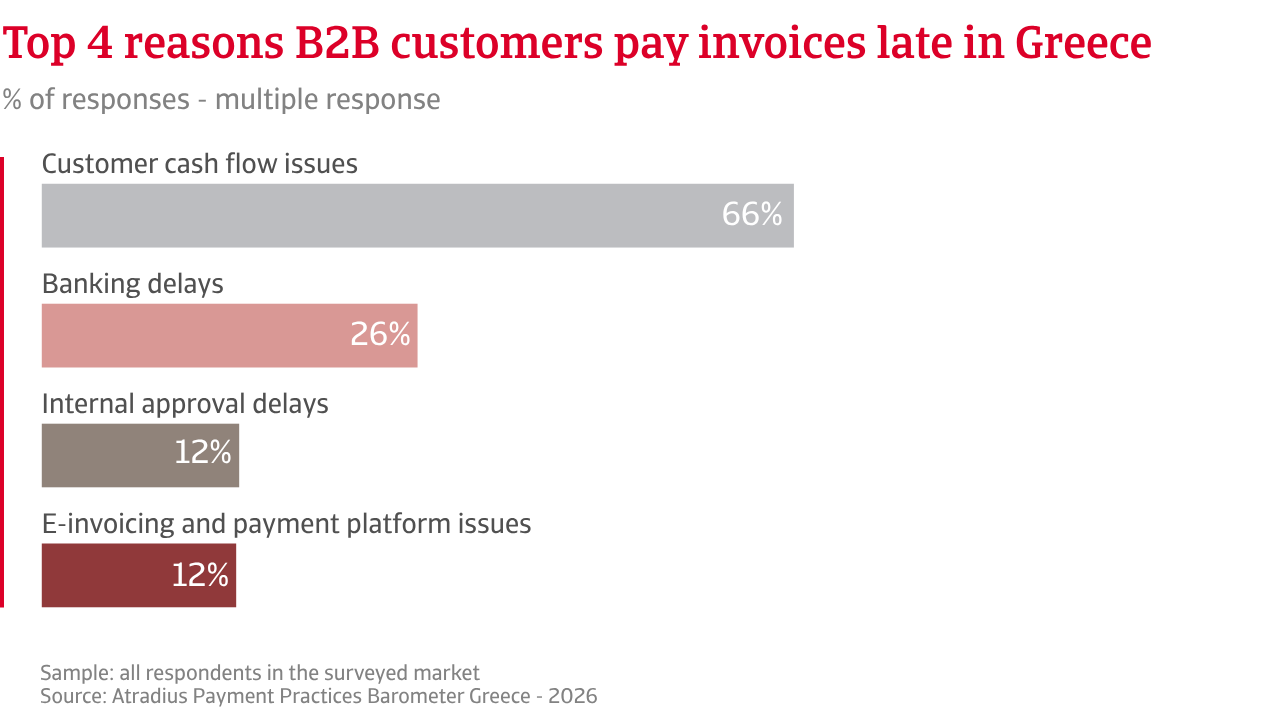
As payment discipline weakens across Western Europe, Greek suppliers experience late payments more often than their regional peers. Around one third of Greek B2B invoices become overdue, compared with one quarter across the region. This gap puts Greek businesses at a disadvantage, as delayed settlements lock up liquidity and intensify working capital pressure. Days Sales Outstanding (DSO) trends reinforce this picture, as fewer businesses in Greece collect payments within one month of invoicing, while more wait up to two months. This signals structural liquidity pressure across the market. Greek companies are also far more likely to link late payment directly to buyer cash shortages. One in two businesses say customer payment risk is limiting day to day cash availability. Write-offs tell the same story. More Greek firms report write offs of up to 1% of B2B invoices than in Western Europe, mainly driven by customer insolvencies. Losses therefore remain limited in amount, but their frequency points to ongoing pressure on cash flow.
To mitigate customer payment risk, Greek companies take a different approach from Western European peers. Tighter payment terms, advance payments and early settlement incentives are used more often than across the region. This reflects focus on easing liquidity pressure arising from trading on credit. Credit insurance remains widely used in Western Europe, but slightly higher uptake in Greece points to greater vulnerability to volatile customer payment behaviour.
Survey evidence shows that almost two thirds of B2B sales in Greece now take place on credit. This sits above the Western European average and underlines how dependent Greek firms remain on supplier financing.

Across Greece, most businesses do not expect any meaningful change in B2B payment behaviour in the short term, as trading conditions remain challenging. This view broadly reflects sentiment across Western Europe. Customer liquidity remains tight in both business environments; interest rates remain high and demand fragile. This means that any improvement in customer payment behaviour is likely to be uneven and fragile, reinforcing cautious trade credit decisions. Ongoing geopolitical disruption and uncertainty around trade prospects during the months ahead are expected to increase strain.
Expectations around insolvency risk highlight how fragile conditions remain. Far more companies in Greece than in Western Europe expect customer insolvency risk to rise in the months ahead. This gap points to a weaker payment environment in Greece, with deeper liquidity stress among businesses. When invoices remain overdue for long, concerns naturally grow that delay may turn into default. Collection cycles across Western Europe are generally shorter, helping to keep payment expectations more stable.
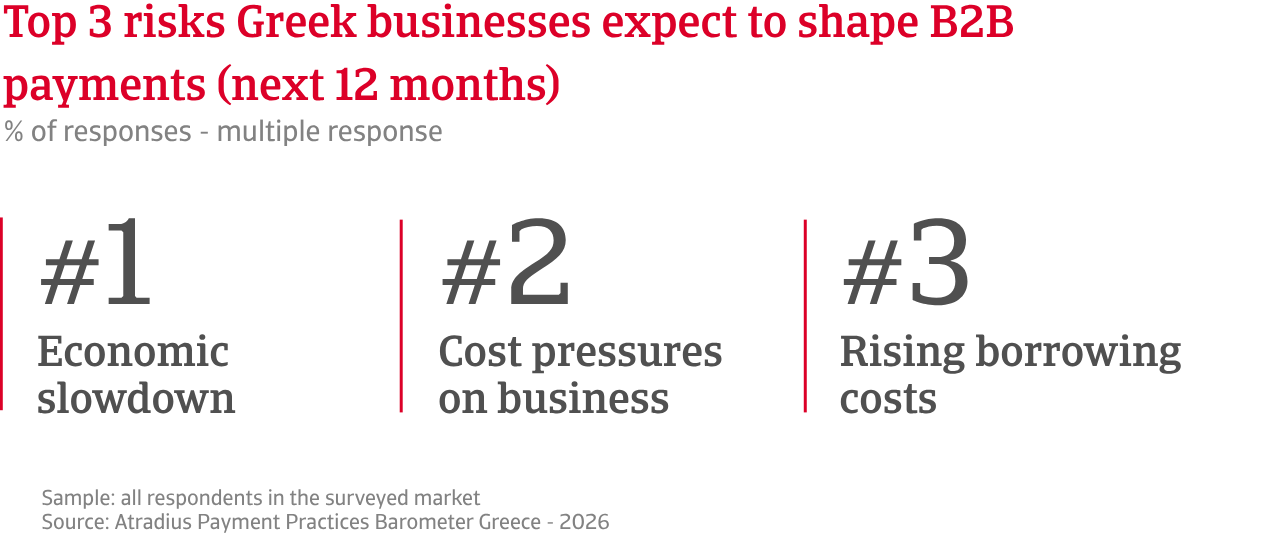
These pressures feed directly into profit margins. Greek firms operate with tighter working capital, slower cash conversion, and limited pricing power. Many accept longer payment cycles to protect demand, pushing up financing and operating costs. As a result, margin pressure is expected to grow more in Greece than in Western Europe, where firms benefit from more predictable payment behaviour and more diversified demand.
Risk perceptions follow a similar pattern. Greece remains highly exposed to any slowdown in global trade and to geopolitical disruptions. While these risks matter across Western Europe, concern is stronger in Greece due to tighter liquidity and greater sensitivity to shifts in economic activity. Thin margins and weaker cash flow leave less room to absorb rising costs, while higher borrowing costs add further pressure. Structural weaknesses in the domestic market, together with the risk of long-lasting trade disruption and Greece's heavy reliance on crude oil imports, are expected to make the payment environment even more fragile and less predictable as the year unfolds.
For a full overview of the 2026 survey results for Greece and Western Europe, please download the market specific report from the related documents section below.
To explore how to strengthen your own credit risk strategy, get in touch with us and see how we can help you stay ahead.
Fragen?
Rechtlicher Hinweis