Atradius Atrium
Atrium - für ein vereinfachtes und transparentes Management Ihrer Kreditversicherungspolice. Login Atradius Atrium

 Deutschland
 Australien
 Belgien
 Brazil
 Bulgarien
 China
China
 Dänemark
Deutschland
Dänemark
Deutschland
 Finnland
 Frankreich
 Griechenland
 Gruppe
 Hongkong
 Indien
 Irland
 Italien
 Japan
Japan
 Kanada
 Litauen
 Mexiko
 Neuseeland
 Niederlande
 Norwegen
 Österreich
 Polen
Polen
 Portugal
 Rumänien
 Schweden
 Schweiz
 Singapur
 Slowakei
 Slowenien
 Spain
Spain
 Tschechische Republik
 Türkei
 Ungarn
 Vereinigte Arabische Emirate
 Vereinigtes Königreich
 Vereinigte Staaten

As survey findings in Indonesia show, just over 40% of the sales that companies make to business-to-business (B2B) customers are currently made on credit terms, in line with the regional average, with the rest paid upfront. This places Indonesia broadly in line with Japan, while the other markets surveyed in the region report shares above or below the regional average. Large trading firms in Indonesia are more likely to extend credit than other segments.
In recent months, the use of trade credit in B2B transactions has increased more strongly in Indonesia than in the region. While Indonesia’s growth remains relatively resilient, tighter liquidity conditions are weighing on many businesses. Extending credit helps keep business moving but also increases exposure to payment risk and requires careful management of receivables to remain sustainable.
Indonesian suppliers combine increased use of B2B trade credit with a relatively tighter grip on payment terms than their regional peers. Most fall within a two-month window, with a slight preference for shorter terms, especially among manufacturing SMEs, reflecting efforts to limit the build-up of longer-dated receivables. Regional trend data show that Asian businesses lengthened payment terms in recent months to support B2B trade, a trend also seen in Indonesia.
Far fewer businesses in Indonesia than across Asia say that B2B payment behaviour has remained unchanged, pointing to a more volatile environment. Although trend data shows improvement outweighing deterioration, especially among manufacturing SMEs supported by shorter payment terms, delays remain widespread. Nine in ten companies report late payments, with around one third of B2B receivables overdue, broadly in line with the region. Mid-sized firms appear to be the most exposed. Trend data also shows that increases in overdue receivables outweigh decreases, affecting a larger share of businesses than across Asia.
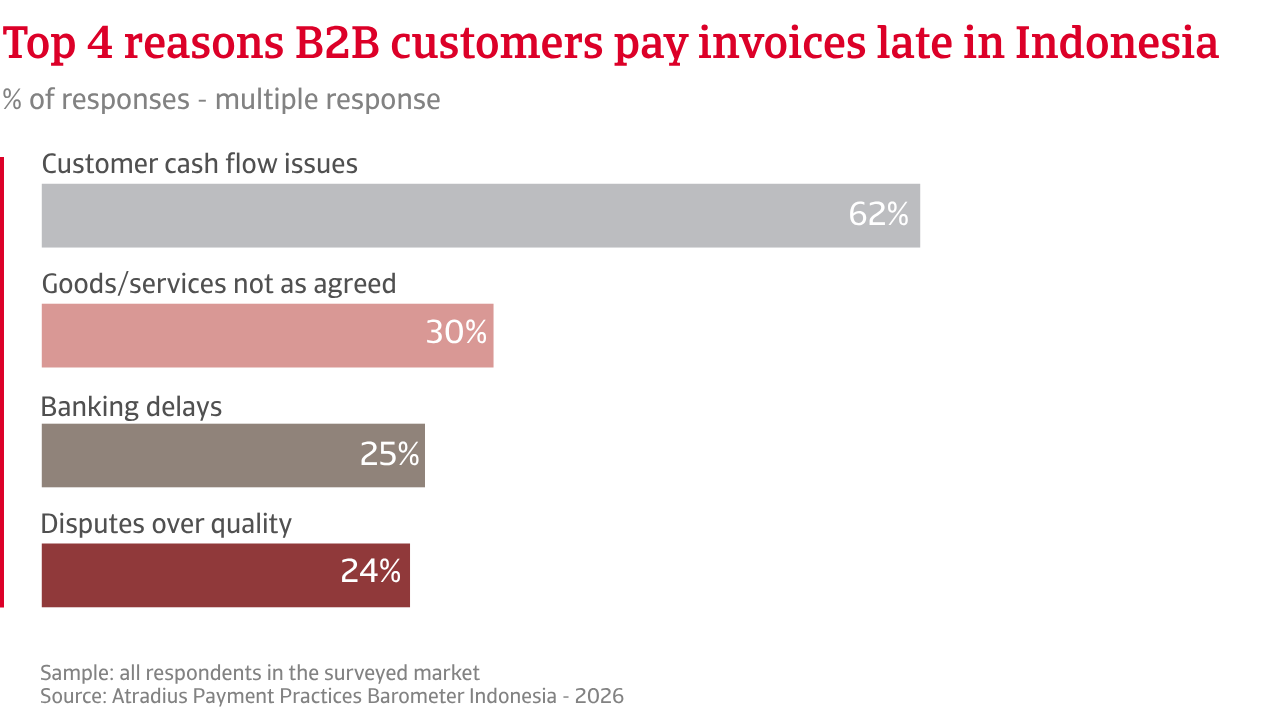
Based on survey responses, B2B customers in Indonesia are far more likely than those across the region to delay payments due to cash flow pressures, pointing to tighter underlying liquidity. Fewer businesses in the market than across Asia report delays related to internal processes, such as complex payment procedures, approval bottlenecks, and invoicing errors. Disputes related to goods and services are slightly more common in Indonesia, pointing to some friction in commercial transactions. Overall, payment delays in Indonesia are driven less by operational inefficiencies and more by customer liquidity constraints. This underlines the need for careful credit risk management, even as companies maintain tighter payment terms.
Survey findings point to a clear gap between agreed payment terms and actual customer payment behaviour in Indonesia, supported by Days Sales Outstanding (DSO) data. Fewer overdue B2B receivables are settled within one month past due than in Asia, although most payments still fall within a two-month window, suggesting short-term rather than longer delays. Trend data suggest collection cycles are improving more quickly than regionally, helping unlock liquidity. However, B2B receivables are typically either collected relatively quickly or written off, rather than remaining outstanding for long periods. Shorter terms and improving DSO do not fully offset customer liquidity pressures, with more companies reporting credit losses above 5% of receivables, increasing pressure on cash flow and margins. These losses are mainly driven by missed payments and customer liquidity issues rather than process bottlenecks, reinforcing the need for early intervention and tight credit control.
The impact of customer payment risk on working capital is stronger in Indonesia than across Asia, particularly in terms of liquidity pressure. Nearly three in five Indonesian companies report less cash available for operations, and close to half say they rely more on external financing, both well above regional averages. This shows how quickly payment delays turn into cash flow pressure, reinforcing earlier findings on customer liquidity constraints and the gap between payment terms and actual behaviour. Despite this, companies are managing the pressure and avoiding wider disruption. They are less likely than regional peers to face higher financing costs or delay payments to suppliers and staff, suggesting they absorb the strain through tighter cash management.
Nine in ten companies report late payments, with around one third of B2B receivables overdue, broadly in line with the region. Mid-sized firms appear the most exposed.
Payment risk mitigation strategies in Indonesia reflect earlier findings. Companies face stronger customer liquidity pressures and higher write-offs and respond with more direct and protective measures. They rely more on bad debt reserves, active credit management, and credit insurance than the regional average. By contrast, early payment discounts are used far less, while negotiating payment terms remains relevant. This reflects market conditions where delays are mainly driven by customer liquidity constraints. The main challenge for Indonesian businesses trading on credit with B2B customers is preventing missed payments from turning into credit losses.

Expectations for B2B payment behaviour in Indonesia point to a more changeable outlook than in the rest of Asia. A larger share of firms expects customers to pay more promptly over the next few months, reflecting growing confidence in collections and tighter credit management. Fewer businesses expect stability, showing that payment patterns are still shifting. The share expecting slower payments is also slightly higher than the regional average, suggesting that uncertainty has not disappeared. This fits with earlier findings. Companies are shortening terms and striving to improve payment collection cycles, but customer liquidity pressures continue to cause short-term delays and some losses. The direction is positive, but the environment remains uneven.
As for the insolvency outlook over the coming months, companies in Indonesia are markedly more pessimistic than across Asia. Most firms expect insolvencies to rise further, while very few anticipate a stable environment. This aligns closely with earlier findings. Although companies are improving collections and shortening payment terms, customer liquidity pressures remain intense. Payment delays are still common, and a higher share of B2B receivables turns into losses. The result is a cautious outlook. Businesses see some improvement in payment behaviour, but do not expect underlying financial stress among customers to ease over the coming months.
While Indonesian companies appear less confident about the financial strength of their B2B customers and remain pessimistic about the insolvency outlook, they are more confident in their own ability to manage cash flow and protect margins. Far more firms than across Asia expect profitability to improve, and very few anticipate a decline.
.2026-07-17-09-48-24.png)
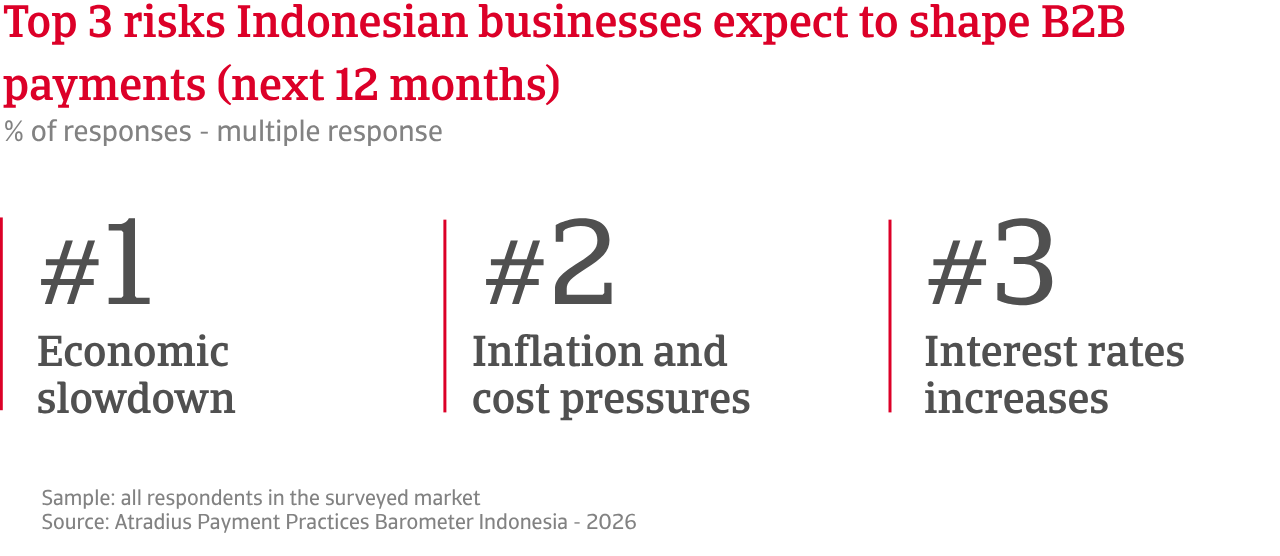
When asked about the main risks expected to affect the outlook for B2B payment behaviour in the coming months, companies in Indonesia anticipate economic slowdown, inflation, and interest rate shifts being the prevailing factors challenging B2B payment behaviour in the market, more so than across Asia. Currency volatility is also more prominent, adding further uncertainty for businesses exposed to external markets. Indonesian companies are less focused on operational or structural risks such as fraud, regulation, and cybersecurity. This reinforces earlier findings that payment challenges are driven primarily by financial constraints rather than process inefficiencies.
Over the coming months, Indonesia’s B2B payment risk outlook will be shaped mainly by macroeconomic headwinds. These pressures are likely to keep payment behaviour volatile and reinforce the importance of strong credit risk management to protect cash flow and contain credit losses.
For a full overview of the 2026 survey results for Indonesia, please download the market specific report from the related documents section below. Insights into Asia are available in the related content section below.
To explore how to strengthen your own credit risk strategy, get in touch with us and see how we can help you stay ahead.
Fragen?
Rechtlicher Hinweis