Atradius Atrium
Atrium - für ein vereinfachtes und transparentes Management Ihrer Kreditversicherungspolice. Login Atradius Atrium

 Deutschland
 Australien
 Belgien
 Brazil
 Bulgarien
 China
China
 Dänemark
Deutschland
Dänemark
Deutschland
 Finnland
 Frankreich
 Griechenland
 Gruppe
 Hongkong
 Indien
 Irland
 Italien
 Japan
Japan
 Kanada
 Litauen
 Mexiko
 Neuseeland
 Niederlande
 Norwegen
 Österreich
 Polen
Polen
 Portugal
 Rumänien
 Schweden
 Schweiz
 Singapur
 Slowakei
 Slowenien
 Spain
Spain
 Tschechische Republik
 Türkei
 Ungarn
 Vereinigte Arabische Emirate
 Vereinigtes Königreich
 Vereinigte Staaten

Companies in Japan currently sell just over 40% of business-to-business (B2B) sales on credit, broadly in line with the regional average, with the rest paid upfront. Japan sits close to markets like Indonesia, while other markets in Asia show wider variation. Within Japan, large trading firms are more active in offering credit, reflecting their stronger capacity to manage risk. While trade credit use is rising across Asia, Japan stands out for its stability, with most firms keeping policies unchanged.
B2B payment terms in Japan are tighter than in the region overall. Most payments are due within one month, and terms rarely extend beyond two months. This reflects a clear focus on fast cash conversion and limiting exposure to delays. SMEs in services tend to use shorter terms, while larger trading firms are more likely to offer longer ones. Unlike the rest of Asia, where firms have recently extended terms to support trade, Japanese companies have largely kept them stable.
Based on survey responses, the payment behaviour of business customers in Japan has remained steady in recent months, with some signs of improvement, creating a predictable environment focused on reliability and long-term trade relationships. Only around one quarter of firms report late payments, with delays affecting less than 10% of receivables, both the lowest shares in Asia. SMEs in trade are the most exposed. While across Asia, payment patterns are more mixed and more volatile, Japan remains consistent.
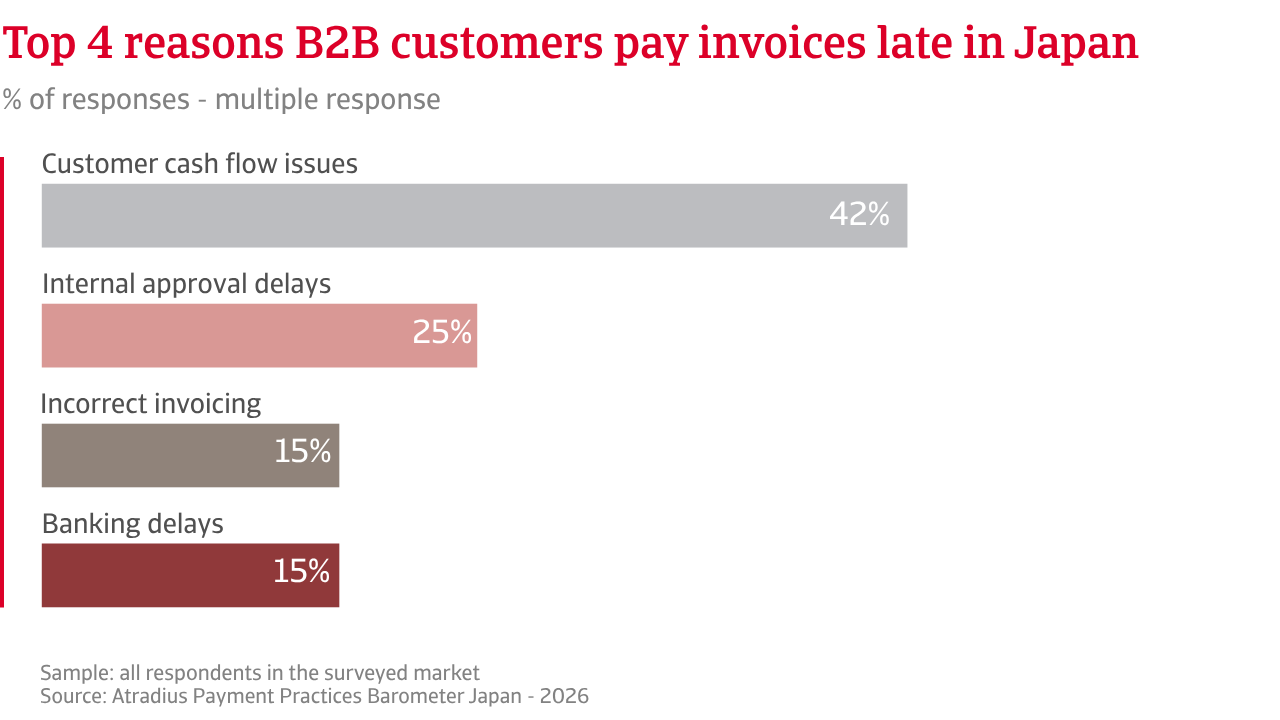
Reasons behind payment delays from business customers also differ between Japan and Asia. Cash flow issues remain the main driver in both, but Japan sees far fewer disputes or delivery-related problems. This suggests stronger alignment between business customers and suppliers. Internal approval processes are a more common source of delays in Japan, reflecting structured decision-making. Across Asia, the causes of late payments are more varied, making payment behaviour less predictable than in Japan.
Short payment terms and quick collections keep receivables under control. Most invoices are paid on time or with only short delays, and overdue payments are typically settled within a month. This limits ageing receivables and supports cash flow. As a result, more than four in five Japanese firms report write-offs below 0.5%, compared with only one in four in Asia, highlighting much lower exposure to bad debt. This translates into a stronger working capital position. Pressures on cash flow, funding, or investment are far less widespread than across Asia, where firms face more financial constraints.
Japan also takes a different approach to managing payment risk. Companies rely less on tools such as credit insurance, advanced credit management, or receivables financing, and more on tight terms, negotiation, and relationship management. Legal action is used more often when needed, suggesting a firm but selective approach. In contrast, Asian firms use a broader mix of tools to manage a more volatile environment.
Overall, Japan offers a stable and predictable credit landscape, built on discipline. While this keeps risks low, it can leave firms exposed to customer payment risk when they seek growth. This is particularly relevant when trading with new customers, entering unfamiliar sectors where information is less complete, or operating beyond the domestic market. In this context, Japanese companies that use credit insurance report that it complements internal credit management, improving visibility on customer risk, supporting trade credit decisions, and protecting receivables against unexpected defaults. In their view, this becomes even more relevant as regional and global economic and trading conditions remain uneven and continue to evolve.
Japan offers a stable and predictable credit landscape, built on discipline. While this keeps risks low, it can leave firms exposed to customer payment risk when they seek growth beyond the domestic market.

When asked about their expectations regarding the outlook for B2B payment behaviour in the months ahead, almost all businesses interviewed in Japan anticipate no significant change. This suggests very low volatility, with fewer risks of sudden shifts in payment behaviour, but also less upside from improving payment performance. In contrast, Asia is likely to see more active shifts in payment behaviour, reflecting a more volatile credit risk environment.
In Japan, insolvencies have climbed to their highest level in more than a decade, after rising gradually over several years. More recently, the pace of increase has slowed, but higher costs and labour shortages are still putting pressure on weaker firms. Against this backdrop, most Japanese businesses expect insolvency levels to stay high but broadly unchanged. This suggests a steady environment, without signs of sharp deterioration. In contrast, companies across Asia are more likely to expect a further rise, pointing to a more cautious outlook. At the same time, fewer firms in Asia are uncertain. Rather than highlighting concern, the higher uncertainty in Japan likely reflects the greater difficulty in anticipating future changes.
.2026-07-20-10-11-40.png)
Profit expectations in Japan point to a cautious but stable outlook. Most companies expect no change, suggesting limited momentum for growth but also no sharp deterioration. In contrast, businesses across Asia are more optimistic overall. A much larger share expects profits to increase, although a similar proportion also anticipates decreases. This reflects a more unpredictable environment. In Japan, the balance is different. Improvement expectations are very low, while the share of businesses expecting decreases is slightly higher than in Asia. This suggests that while stability dominates, downside risks remain present, likely linked to ongoing cost pressures and structural challenges.
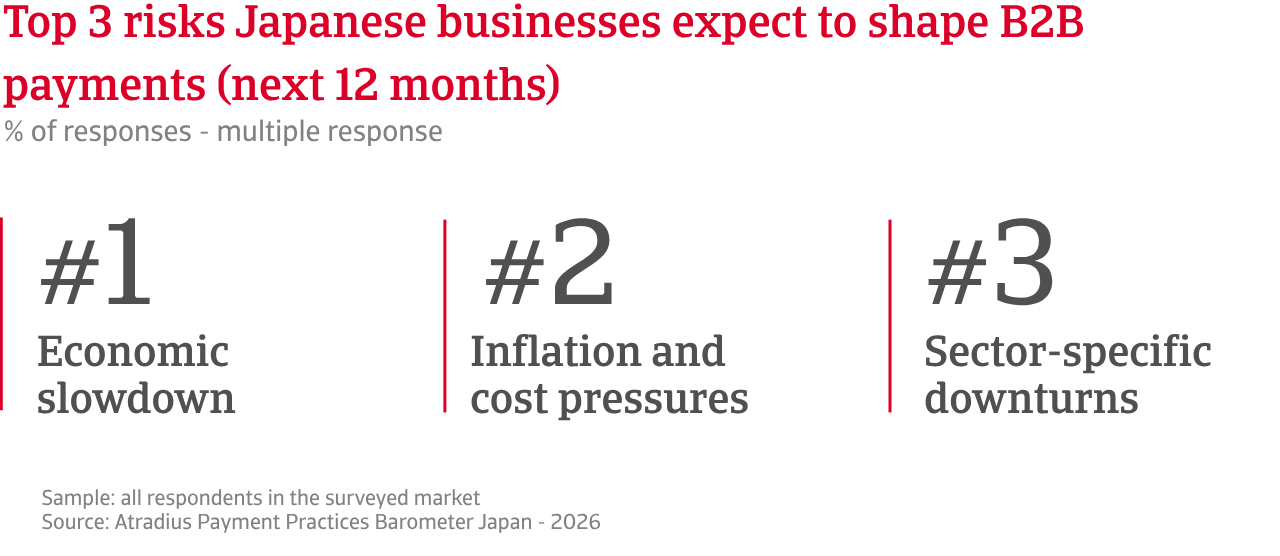
While businesses across Asia anticipate a broader and more mixed risk landscape shaping B2B payment behaviour as the year unfolds, Japan shows a more focused risk profile. Concerns centre on domestic macroeconomic conditions and sector-specific weaknesses. The very high share citing economic slowdown, alongside strong concern about sector downturns, suggests that risks are seen as internally driven. In contrast, businesses across Asia report a wider range of risks. Alongside economic and cost pressures, they highlight geopolitical instability, cybersecurity, and fraud, indicating a more complex and multi-layered risk environment. Financial risks also play a different role. While interest rates are a bigger concern across Asia, Japanese firms appear less exposed. Currency risk remains relatively contained in both cases, although it is slightly more relevant for Japanese businesses, reflecting greater sensitivity to exchange rate shifts.
For a full overview of the 2026 survey results for Japan, please download the market specific report from the related documents section below. Insights into Asia are available in the related content section below.
To explore how to strengthen your own credit risk strategy, get in touch with us and see how we can help you stay ahead.
Fragen?
Rechtlicher Hinweis