Atradius Atrium
Atrium - für ein vereinfachtes und transparentes Management Ihrer Kreditversicherungspolice. Login Atradius Atrium

 Deutschland
 Australien
 Belgien
 Brazil
 Bulgarien
 China
China
 Dänemark
Deutschland
Dänemark
Deutschland
 Finnland
 Frankreich
 Griechenland
 Gruppe
 Hongkong
 Indien
 Irland
 Italien
 Japan
Japan
 Kanada
 Litauen
 Mexiko
 Neuseeland
 Niederlande
 Norwegen
 Österreich
 Polen
Polen
 Portugal
 Rumänien
 Schweden
 Schweiz
 Singapur
 Slowakei
 Slowenien
 Spain
Spain
 Tschechische Republik
 Türkei
 Ungarn
 Vereinigte Arabische Emirate
 Vereinigtes Königreich
 Vereinigte Staaten

Within a weakened economic backdrop, marked by slower growth, tighter financial conditions and persistent inflation driven by geopolitical tensions, the operating environment in Slovakia has become increasingly fragile. Insolvency pressures are gradually building, with data pointing to growing financial distress for firms, particularly in sectors exposed to external demand and extended supply chains.
Against this backdrop, trade credit remains widely used by Slovak firms. Just under half of B2B sales are conducted on credit, broadly in line with the CEE average. SMEs in construction lead usage. Survey data shows a clear increase in credit-based sales in B2B trade, with businesses relying on it to sustain demand, strengthen relationships and remain competitive within export-driven value chains. This expansion appears stronger than the broader regional trend.
Payment terms reflect a more targeted approach. Slovak firms more frequently offer 30-day terms than peers in the region, aiming to protect liquidity and speed up cash conversion. At the same time, longer terms above three months from invoicing appear more often in selected cases. This suggests a targeted use of extended credit to retain key clients, consistent with an export-oriented economy.
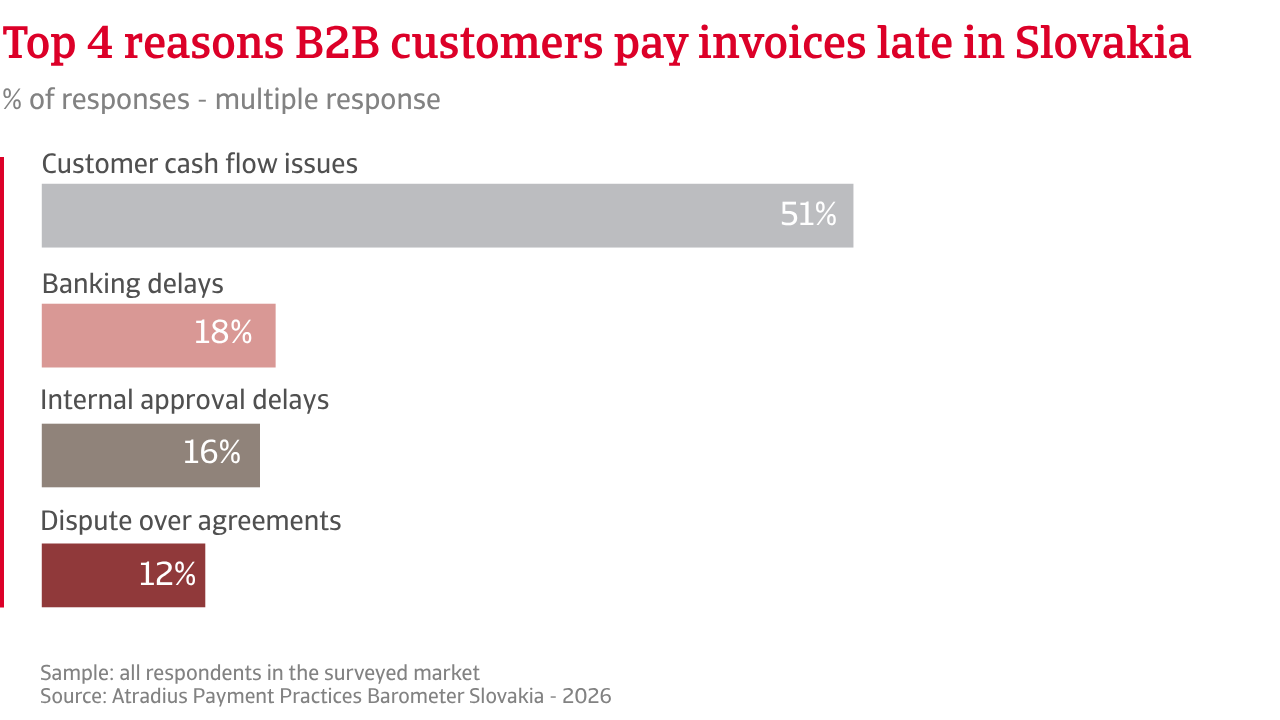
Payment behaviour in B2B trade has weakened in recent months. Nearly all firms report delays, slightly above the regional average. Payment risk has increased, but not evenly. Some customers remain disciplined, while others, notably in sectors with long contracts and complex supply chains, face significant delays. This reflects both financial stress and operational issues such as disputes and administrative bottlenecks.
Once B2B invoices become overdue, they tend to remain unpaid for longer. While initial delays mirror the CEE average, overdue receivables in Slovakia are more likely to drift into longer categories, pushing up Days Sales Outstanding (DSO and increasing pressure on cash flow, particularly among smaller manufacturers.
Credit losses are rising as more invoices stay unpaid for longer. This increases the risk that companies will not be paid at all. In Slovakia, losses are more often caused by customers going insolvent or by legal disputes than in other countries in the region. This shows that late payments are not just temporary issues. They often reflect deeper problems in the economy and in how businesses operate.
Late or missed payments affect more than just daily cash. To cope, Slovak businesses borrow more, pay higher financing costs and delay investment. They often accept more risk from customers to win and keep business. To manage this risk, they build reserves, monitor customers more closely and use credit insurance slightly more often than others in the region. This helps firms stay competitive, especially in export markets, but it also means they are more exposed if customers fail to pay.
Slovak firms more frequently offer 30-day terms than peers in the region, aiming to protect liquidity and speed up cash conversion. At the same time, longer terms above three months from invoicing appear more often in selected cases.
Against a weaker economic backdrop, expectations for B2B payment behaviour show a cautious shift. Fewer companies in Slovakia than in CEE expect the payment behaviour of their business customers to remain unchanged. Among those expecting change, most believe conditions will stabilise rather than worsen. This points to a gradual shift in sentiment, although underlying pressure remains. Businesses expect payment cycles to settle over time, rather than improve significantly.
At the same time, many Slovak firms expect insolvencies to rise. While payment behaviour may stabilise overall, weaker companies continue to struggle and may go out of business. Stronger firms appear better able to manage payments and adjust to current conditions, but a significant share of businesses remains under pressure. This pressure is particularly visible in sectors with long payment cycles, where delays can build up quickly, and in industries exposed to external demand.
As to profit expectations, Slovak firms expect margins to gradually improve and are more optimistic than their regional peers. However, this confidence mainly reflects stronger businesses. Others remain under pressure, leading to a more uneven outlook.
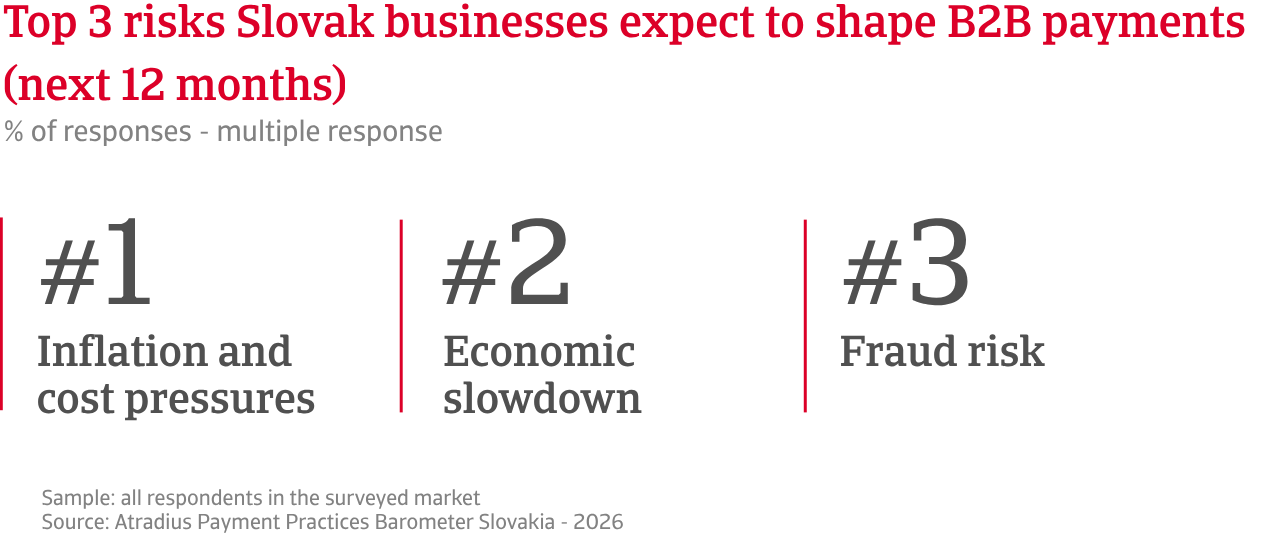
Risk concerns also differ from the wider region. While businesses across CEE focus mainly on general economic risks, Slovak firms are more concerned about inflation and rising costs. This shows that margins are tight and costs remain uncertain. Companies are also more worried about risks in specific sectors, especially in export‑focused industries and complex supply chains.
There is also growing concern about transaction risks, such as fraud and whether customers can pay. This reflects more late payments and losses linked to disputes or insolvencies. By contrast, risks such as geopolitics or currency changes are less of a priority. Companies are more focused on day‑to‑day operational challenges.
Overall, the situation is uneven. Slovak businesses are focusing more on managing risks in their transactions and customer relationships, rather than relying only on broader economic trends.
For a full overview of the 2026 survey results for Slovakia, please download the market specific report from the related documents section below. Insights into Central and Eastern Europe (CEE) are available in the related content section below.
To explore how to strengthen your own credit risk strategy, get in touch with us and see how we can help you stay ahead.
Fragen?
Rechtlicher Hinweis