Atradius Atrium
Atrium - für ein vereinfachtes und transparentes Management Ihrer Kreditversicherungspolice. Login Atradius Atrium

 Deutschland
 Australien
 Belgien
 Brazil
 Bulgarien
 China
China
 Dänemark
Deutschland
Dänemark
Deutschland
 Finnland
 Frankreich
 Griechenland
 Gruppe
 Hongkong
 Indien
 Irland
 Italien
 Japan
Japan
 Kanada
 Litauen
 Mexiko
 Neuseeland
 Niederlande
 Norwegen
 Österreich
 Polen
Polen
 Portugal
 Rumänien
 Schweden
 Schweiz
 Singapur
 Slowakei
 Slowenien
 Spain
Spain
 Tschechische Republik
 Türkei
 Ungarn
 Vereinigte Arabische Emirate
 Vereinigtes Königreich
 Vereinigte Staaten

According to survey data, companies in Taiwan currently transact around 40% of B2B sales on credit terms, with most still settled upfront. This positions the market among the most cautious in Asia, broadly aligned with Hong Kong and slightly ahead of mainland China in terms of trade credit usage. Taiwan’s cautious use of trade credit in B2B transactions highly likely to reflect a strong focus on liquidity and balance sheet resilience, shaped by high exposure to volatile global demand. Mid-sized and large firms in construction and trade are more likely to extend trade credit to business customers than other segments in the market.
Trend data show that more firms in Taiwan have increased, rather than decreased, the use of B2B trade credit in recent months. This reflects the need to extend credit to retain customers, particularly in export markets where flexibility is expected. While this is consistent with the wider regional trend, Taiwanese businesses remain more cautious than their peers, reflecting heightened risk awareness and sector exposure.
Payment policies among Taiwanese suppliers point to a highly selective credit strategy. While terms of up to one month are offered to business customers almost as often as regional peers do, standard two-month terms, widely used across Asia, are less common in Taiwan. Suppliers are instead more likely to extend longer terms selectively to specific customers, typically key customers or export partners. This suggests that Taiwanese firms do not compete through the overall volume of credit, but rather through targeted flexibility that supports strategic commercial relationships. Larger companies, particularly those active in trade, are more likely to report this approach than other business segments. Trend data show that businesses across Asia have been extending payment terms in recent months to support B2B trade. Taiwan follows the same pattern, with firms doing so more often than elsewhere in the region.
Longer payment terms delay cash inflows, increasing exposure to customer payment risk. This is particularly relevant for an export-driven economy, where firms may have less visibility over the financial health of overseas customers and may rely on a small number of key buyers, where payment risk concentrates. This is likely one of the reasons why more firms in Taiwan report worsening B2B payment behaviour than elsewhere in Asia.
Currently, overdue invoices account for just over one third of B2B receivables, above the regional average, with mid-sized construction firms among the hardest hit. Trend data supports this view. More businesses in Taiwan report increases in late payments than decreases, broadly in line with the regional trend, but affecting a much larger share of firms in the market than regionally.
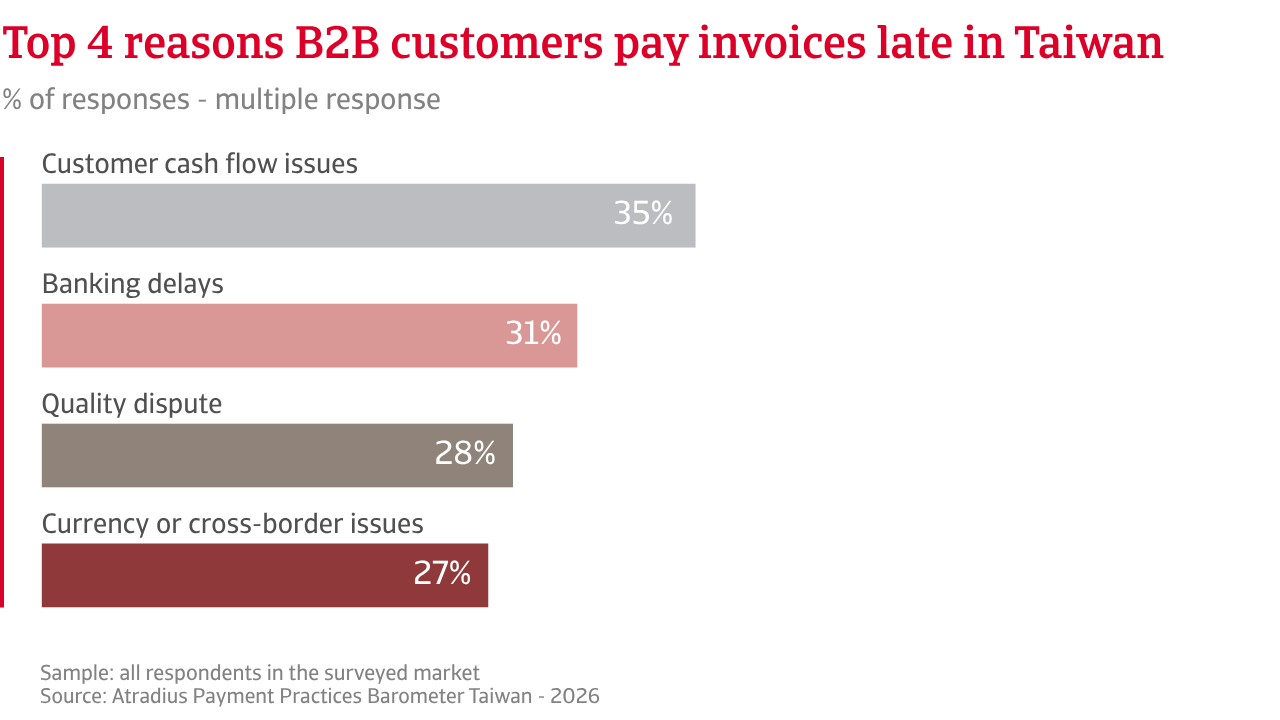
Unlike what is most often reported across Asia, late payments in Taiwan are mostly driven by banking delays, factors that slow down or complicate international payments, and invoicing errors than by customer liquidity constraints. This tallies with Taiwan’s deep integration into global trade, with exports accounting for a large share of activity. Since payment delays are more often linked to the complexity of transactions than to customers’ ability to pay, this may explain their widespread impact despite the cautious approach to trade credit use shown by Taiwanese suppliers.
Overall, survey data suggest a more challenging credit environment in Taiwan. Lenient payment terms, often tied to complex cross border trade, support trade flows but also extend collection cycles, as reflected in Days Sales Outstanding (DSO), tying up liquidity and increasing the risk of bad debt write-offs. This is reflected in survey data, which show a higher share of firms in Taiwan reporting credit losses of 1% to 5% of B2B receivables than across Asia overall. Taken together, these factors point to significant working capital stress for businesses in Taiwan.
Unlike their regional peers, who are more likely to rely on external financing to absorb payment delays, Taiwanese firms face stronger pressure on capital costs and investment capacity. Nearly half report higher funding costs and constraints on growth, alongside a greater need to delay their own payments to suppliers and reduced financial flexibility. This suggests that payment disruptions feed more directly into operational decisions in Taiwan than elsewhere in Asia.
Customer payment risk mitigation strategies in Taiwan reflect a more active, operational approach than in Asia. While reserves and credit insurance are used at similar levels, firms rely more on day-to-day credit management including monitoring, collections, early payment incentives, and secured terms. At the same time, fewer firms shorten payment terms or take legal action, focusing instead on managing risk within existing relationships. Taiwanese businesses are also slightly more likely to diversify customers and use receivables financing, though these remain secondary tools. These findings confirm that Taiwan’s credit environment has become more challenging, prompting firms to heighten protection of working capital against the impact of customer payment risk.
Companies in Taiwan currently transact around 40% of B2B sales on credit terms, with most still settled upfront. This positions the market among the most cautious in Asia.

Based on survey responses in Taiwan, expectations around B2B payment behaviour point to ongoing pressure across the market. While businesses in Asia show a broadly balanced outlook, the picture in Taiwan is more cautious. Only a limited share of companies expects B2B customers to pay invoices in a more timely manner, while a higher proportion anticipate slower payments and over half expect no change. This suggests that recent weaknesses in payment behaviour are not seen as temporary. Instead, firms in Taiwan expect current conditions to persist, with delays remaining elevated. This aligns with earlier findings of longer, more selective payment terms and higher exposure to transaction complexity, both of which contribute to slower and less predictable cash inflows.
As payment policies become more lenient, transaction complexity increases, and B2B payment behaviour weakens, more Taiwanese firms expect financial stress among customers to increase. Unlike the more balanced outlook across Asia, most businesses in Taiwan expect this to trigger an increase in insolvencies in the coming months, at a significantly higher rate than the regional average, while fewer companies anticipate that current levels will simply remain elevated. Very few firms in the market express uncertainty, suggesting a more defined and widely shared view of increasing risk.
Although Taiwanese companies appear to actively manage customer payment risk to minimise its impact on the business, slower cash inflows coupled with higher capital costs are expected to constrain profit margin improvement in the coming months. While expectations remain more positive across Asia, most Taiwanese firms expect margins to remain unchanged, and a slightly higher share anticipate a decline.
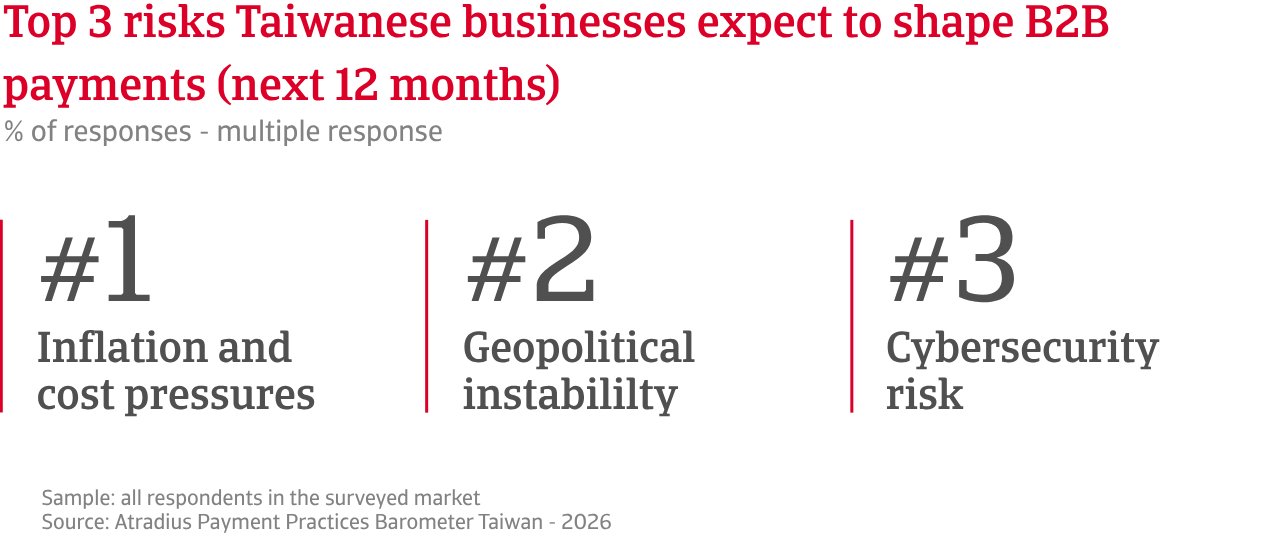
When asked about the main risks that are likely to disrupt B2B payment behaviour in the months ahead, companies in Taiwan point primarily to geopolitical instability, which reflects exposure to international trade and global supply chains. They also highlight cybersecurity threats and fraud, expressing concern over rising operational risks linked to more complex and digitalised transactions. In contrast, and unlike the broader regional picture, concerns about macroeconomic risks such as economic slowdown, inflation, and rising interest rates are less prominent among Taiwanese firms. This suggests that potential disruptions to B2B payment behaviour in the months ahead are likely to be driven less by demand weakness and more by uncertainty, geopolitical risks, and transaction complexity. This aligns with survey findings showing that payment risks for Taiwanese firms stem less from customer liquidity and more from cross-border and operational challenges.
For a full overview of the 2026 survey results for Taiwan, please download the market specific report from the related documents section below. Insights into Asia are available in the related content section below.
To explore how to strengthen your own credit risk strategy, get in touch with us and see how we can help you stay ahead.
Fragen?
Rechtlicher Hinweis